


Last Updated on:October 31th, 2024
Mica has been a long-time friend in our country, Japan. Since mica has shimmering properties, it used to be called “Kira” or “Kirara” which are Japanese onomatopoeia of light reflection.
Because Mica creates a translucent white like Gofun pigment rather than opaque white, it is not directly used as a paint, but instead, it is mixed with other pigments or applied thinly to other substrates like effect pigments to create a shimmering effect.
It also has a wide range of other benefits such as an electrical insulator, heat-resistant material, herbal medicine, and insect repellant in ancient times.
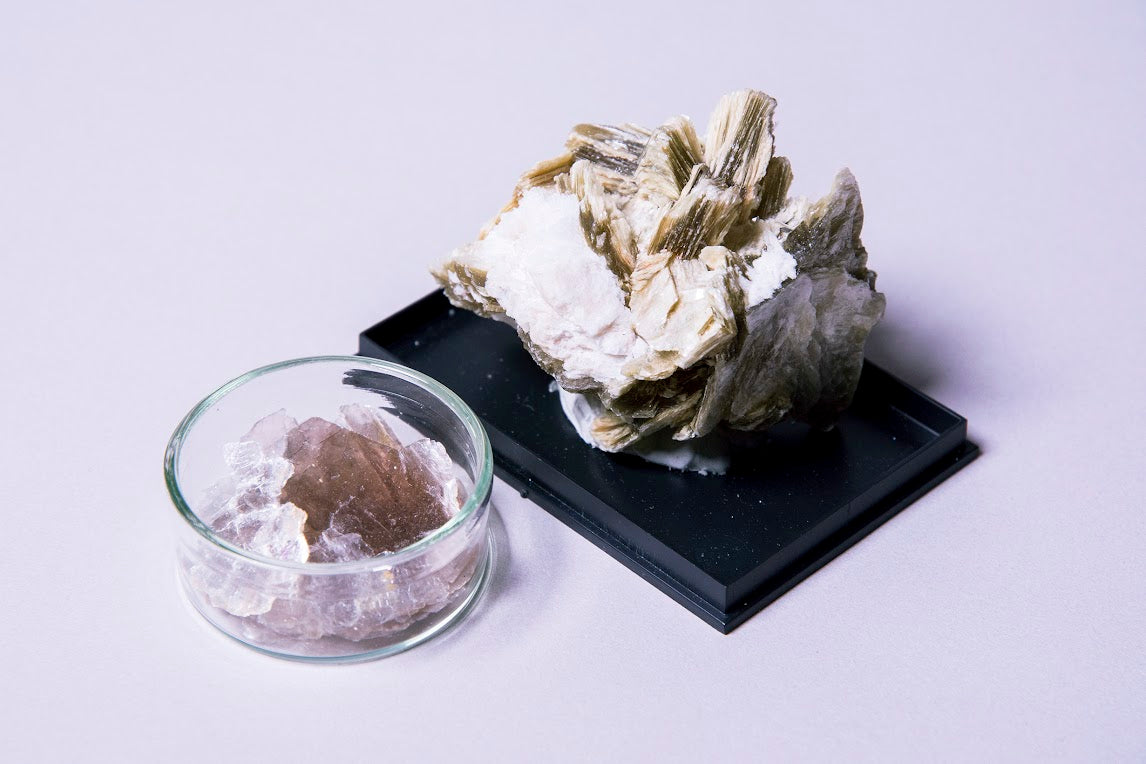
Here is a photo of the mica ore.
Japan isn’t the only country that used mica in art. Although the technique used is slightly different in Japanese art, it was a popular building material in Europe because it’s easy to process and was known as Serena stone (mica schist).
For instance, a circular painting (tondo), "The Virgin and Child, and Angels (Madonna of the Magnificat)" in the Uffizi Museum collection has a window frame painted with the mica, which is indicative of the Florentine architectural style of the 14th century.
Let me now return to Japanese art. The famous ukiyo-e print, “Ōtani Oniji III in the Role of the Servant Edobei” by Tōshūsai Sharaku was also made by mica-printing technique.
People in Edo (the former name of Tokyo) must have been fascinated by the shimmering glitter that shines from different angles, just as modern people are enjoying trading cards printed with glitter that is in a renewed boom in recent years.

《Kabuki Actor Ōtani Oniji III as Yakko Edobei》Tōshūsai Sharaku,1794,The Metropolitan Museum of Art
In other artworks, mica was often used to give a shimmery effect to paint snow. In “Snowy Landscape,” hazy peaks, a typical motif in ink wash paintings, are skillfully depicted by using the contrast of Sumi ink and mica.

《Snowy Landscape》Toki Tōbun,ca. 1550,The Metropolitan Museum of Art
Although you have seen mica used in paintings, have you ever imagined what actual mica looks like before turning into paint? In pigiment.live, we have three types of mica with different particle sizes. Mica has properties that are easily split into extremely thin elastic plates, therefore the shape of particles is not round, but instead more like a small plate.

As I mentioned above, mica pigment is translucent and does not have high covering power, so there is no significant change when applied on the surface by itself.
However, simply mixing it with other paints will show obvious differences.
In this article, I tried mixing three particle sizes of the mica pigments which are coarse, medium, and fine with different binders.


【Art Materials Used】
Top: Acrylic Paint Cadmium Yellow Orange (MATSUDA OIL COLOR) / Mica Coarse (NAKAGAWA GOFUN ENOGU)
Middle: Quinacridone Violet (Holbein Art Materials)/ Mica Medium (NAKAGAWA GOFUN ENOGU)
Duo Quick Drying Liquidt (Holbein Art Materials) *Sorry, this item is no longer available.
Bottom: Suihi Wakaba / Mica Fine (NAKAGAWA GOFUN ENOGU)
Gum Arabic Watercolor Medium (KUSAKABE)
Bamboo Washi for Watercolor Art Card (Awagami Factory)


I added binders with different properties such as acrylic paint, Duo medium and gum arabic to mica pigments. With the change of the binders, you can tell the difference in texture more easily for each coarseness.
Now, let's begin our observations from the top.
Coarse mica is used to give roughness to the painting surface more than its effect of adding luster to it. Rather than a uniform, artificial texture like when mixed with a medium of sandy material, it can create a natural shimmering surface while keeping the texture of mica's flakes.
The medium grain has a more intense luster than the coarse grain mica pigment. This grain size has the best particle size to give a glossy appearance to the painted surface. If you prefer the shine of mica, you should first try medium grain size mica pigment.
Mixing paint with the fine-grain mica pigment increases opacity and gives a slightly matte texture to the painted surface. Although it looks matte at first glance, it mysteriously glows when viewed from different angles or by changing light sources. This texture is difficult to capture with the camera, so please give it a try yourself.
Alternatively, mica pigment can be sprinkled on the surface where the adhesive was applied to create a rough, Sunago (metal leaf glitters)-like texture.
I applied a thin layer of the matte medium as an adhesive and sprinkled mica by hand. As a tip, you can use Sunagozutsu, a bamboo sieve for making metal leaf glitter to sprinkle the mica evenly over the entire surface.
We offer six types of Sunagozutsu ranging from rough mesh to fine mesh. You can choose the type depending on the particle size of the mica pigment used.
I recommend Arame (Coarse), Chume (General flaky), and Hosome (Fine) for the use of mica carried at pigiment.live.

The word "Unmo," mica in Japanese, tends to make people think of this pigment as a Japanese-style painting material, but in fact, it has many possibilities to be used in all kinds of artistic expression. It is also fun to enjoy the glittering effect of the painted surface from different angles.
Therefore, I hope you will find your own unique way to explore with mica!
References
Uffizi Gallery: Art, History, Collections, Translated by Harumi Matsumoto (GUNTI, 2006)
A Dictionary of Colors in Japan, Sachio Yoshioka and Denji Fukuda (Shikosha Publishing Co., 2000)
[Special Workshop on Nov 3, 2026] Mastering Effect Pigments with SUSONITY JAPAN
With English Interpretation!

[Special Workshop] Mastering Effect Pigments with SUSONITY JAPAN
What You Will Experience

Art Materials Expert at pigiment.live
Akira Oya
Born in 1989 in Tokyo. Master of Fine Art and Design at Nihon University College of Art.
He also continues his career as a visual artist.
Born in 1989 in Tokyo. Master of Fine Art and Design at Nihon University College of Art.
He also continues his career as a visual artist.

Translator
Atsumi Okano
Completed her post-baccalaureate program at the School of the Art Institute of Chicago in Painting and Drawing.
While working with PIGMENT ARTICLES mainly as a translator, she also creates paintings and installations with translucent materials as an artist.
Favorite matière: Interaction of intentionality and coincidence created by the layers of transparent materials and colors.
Completed her post-baccalaureate program at the School of the Art Institute of Chicago in Painting and Drawing.
While working with PIGMENT ARTICLES mainly as a translator, she also creates paintings and installations with translucent materials as an artist.
Favorite matière: Interaction of intentionality and coincidence created by the layers of transparent materials and colors.

Translator
Nelson Hor Ee Herng
Graduated with a BFA in Japanese painting from Tama Art University. Using paintings, embroideries and installations to document issues related to our modern society.
Favorite material: Mineral pigments used by ancient people to paint murals.
Graduated with a BFA in Japanese painting from Tama Art University. Using paintings, embroideries and installations to document issues related to our modern society.
Favorite material: Mineral pigments used by ancient people to paint murals.